

Reuse isn't a lifestyle choice. It's an economic imperative for any society that's serious about operating within environmental limits. The math of single-use, even with perfect recycling, doesn't add up. Reuse is the only material system that does.
This is the case for reuse as the center of the next phase of Australian environmental policy and consumer behavior, not as one option among many. For a closer look at why recycling alone falls short, the structural reasons more recycling can't catch up to growing consumption, see our piece on why recycling won't save us from overconsumption.
Why Recycling Alone Can't Work
Australian household curbside recycling recovers a minority of household waste; the majority goes to landfill. The reasons are structural, not motivational:
- Plastic recycling degrades the polymer with each cycle; most plastic is recyclable a limited number of times before becoming non-recyclable.
- Soft plastics have no widespread Australian recycling infrastructure since the 2022 REDcycle disruption.
- Composite materials (paper-plastic laminates, foil-lined cartons) are typically not recyclable at all.
- Contamination from food residue degrades the recyclate value, with significant fractions of "recycled" material ultimately landfilled.
- Recycling is energy-intensive, with substantial emissions per tonne recovered.
Even major improvements in Australian recycling rates would not address the core problem: Australia produces too much disposable material in the first place.
The Reuse Math
Compare a single-use cup, perfectly recycled, against a reusable cup:
The disposable cup, recycled, requires: raw material extraction every cycle, manufacturing every cycle, transport every cycle, washing or sorting every cycle, collection and reprocessing every cycle. The per-use environmental cost is the full lifecycle cost spread over one use.
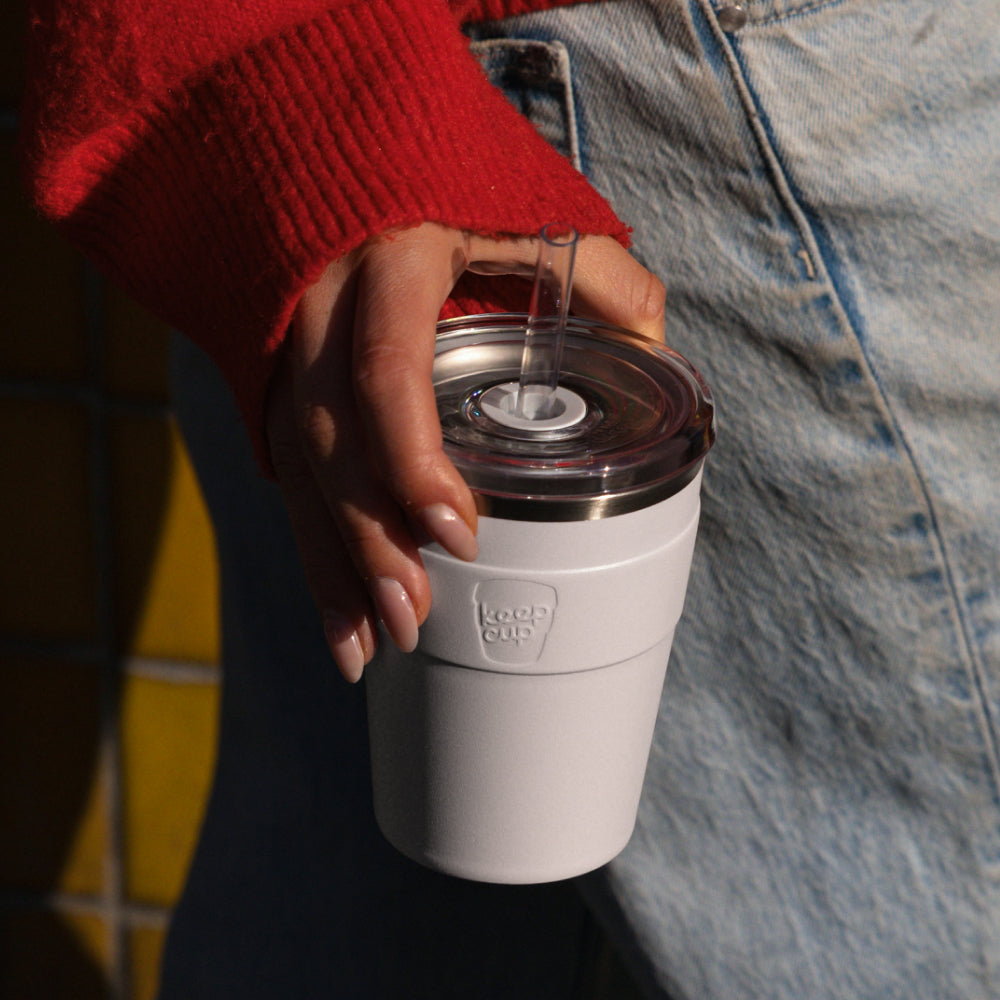
The reusable cup requires: raw material extraction once, manufacturing once, transport once, daily washing (a fraction of a disposable cup's manufacturing energy). The per-use environmental cost is the lifecycle cost spread over hundreds of uses.
Reuse beats recycling by a wide margin on most lifecycle measures, emissions, water use, raw material extraction, waste generation. This is a structural advantage that no improvement in recycling efficiency can close.
What KeepCup Customer Data Shows
KeepCup products are tested to 1,000 uses. With modular replacement parts (lids, seals, bands) available across the range, the service life extends well beyond that. For a daily coffee drinker, a single quality reusable replaces a substantial cumulative volume of disposable cup consumption across its life.
The same logic applies across categories, bottled water, to-go containers, shopping bags, packaged groceries, single-use cleaning products. The combined cumulative impact of household reuse, applied across categories, is substantial across Australia.
The Behavioral Barriers
If reuse is so obviously better, why doesn't it dominate? Five structural barriers:
1. Disposable Convenience
Single-use products are designed for one-decision convenience. Take, use, discard. The cognitive load is minimal. Reusable products require ongoing decisions, carrying, washing, maintaining. The convenience advantage of disposables is real and shouldn't be underestimated.
2. Capital Outlay
A disposable cup costs the consumer little per use (often hidden in the drink price). A reusable cup costs more upfront and substantially less per use over its lifetime. The reusable is dramatically cheaper across the lifecycle but requires an upfront commitment that disposables don't.
3. Forgetting
The largest reason for disposable use among committed reusable owners is forgetting to bring the reusable. The friction of remembering to carry is the single biggest behavioral failure mode.
4. System Compatibility
Some venues don't accept reusables (often unfounded health concerns), don't price-incentivize them (small but symbolic), or actively discourage them (rare but it happens). The system doesn't always support the behavior.
5. Cultural Defaults
In many contexts, disposable is still the default cultural choice. Coffee on the way to work is assumed disposable. Water at a meeting is assumed bottled. To-go is assumed in disposable containers. Changing the default takes sustained effort, not occasional intention.
What Works to Shift Reuse Behavior
The evidence base from a decade of reuse program evaluation:
- Default switching. Make reusable the default and disposable the exception. Cafes that ask "is this for here?" and serve in ceramic by default see substantially higher reuse rates than cafes that serve in disposable by default.
- Visible pricing. A discount for reusable, or a surcharge for disposable, signal that one is preferred. Even small signals significantly shift behavior.
- Workplace distribution. Distributing reusable cups at workplace onboarding outperforms expecting employees to bring personal cups.
- Loaner pools. A small fleet of loaner cups solves the "I forgot" failure mode without adding cost or complexity.
- Replacement parts. Easy replacement of damaged components prevents the discard-and-revert failure mode.
None of these are speculative. All are demonstrated in case studies across the LinkedIn Dublin, Bank of England, Single O Sydney, and other reuse programs KeepCup has worked on.
The Policy Frame
Reuse-enabling policy has lagged consumption-enabling policy almost everywhere. The infrastructure for disposables is sophisticated, mature and subsidized. The infrastructure for reuse is patchy.
The policy reforms that would shift the balance:
- Extended producer responsibility. Make manufacturers responsible for end-of-life of their products. This shifts the economic case toward reuse and away from disposables.
- Container deposit expansion. Include disposable coffee cups in container deposit schemes. Apply the price signal currently working for bottles.
- Reuse infrastructure investment. Public wash stations, return-and-reuse systems, infrastructure for shared reuse services.
- Government procurement preferences. Government purchasing biased toward reusable solutions creates market demand for the alternative.
- Default-switching regulations. Requirements that cafes serve in reusables by default, with disposables on request only.
Why It Matters Beyond Coffee Cups
The reuse imperative isn't really about coffee cups. It's about whether modern consumer economies can operate within material limits, or whether they require ever-expanding disposable throughput to function.
The disposable economy is incompatible with environmental limits. Recycling can soften the impact but can't reverse the throughput. Reduction, the first principle of the waste hierarchy, requires reuse at scale.
The next decade is when reuse either becomes the cultural and infrastructural default, or remains a niche choice for a committed minority. The trajectory matters. The investment in the systems that support reuse matters.
The KeepCup Position
KeepCup exists to make reuse practical. Our products are designed for the reuse use case, durable, repairable, modular, scaled across hot, cold and food applications, and tested to 1,000 uses. Our advocacy is for the systemic shifts that make reuse easier.
We don't pretend reuse is effortless or that we've solved every failure mode. We do believe it's the only material economy that adds up across environmental and economic dimensions, and that the work of getting there is among the highest-impact work available to consumer brands, policymakers and customers today.
FAQs
Why isn't recycling enough?
Recycling recovers a minority of household waste, degrades plastic with each cycle, and doesn't address the growth of disposable consumption. Reuse outperforms recycling on most lifecycle measures.
What's the biggest barrier to reuse?
Forgetting. The single largest cause of disposable use among committed reusable owners is forgetting to carry the reusable. Permanent carry of a reusable cup, bottle and bowl solves most of the problem.
What policies support reuse in Australia?
Extended producer responsibility, container deposit expansion to include coffee cups, default-reusable regulations in food service, government procurement preferences, and public investment in reuse infrastructure.
How long does a KeepCup last?
KeepCup products are tested to 1,000 uses. Modular replacement parts (lids, seals, bands) extend service life beyond that.
Why recycling won't save us from overconsumption
Towards zero waste at KeepCup HQ